Rising costs narrowed the field. After weeks of watching the 16GB variant of the Radeon 9060 XT climb in price... I took the plunge.
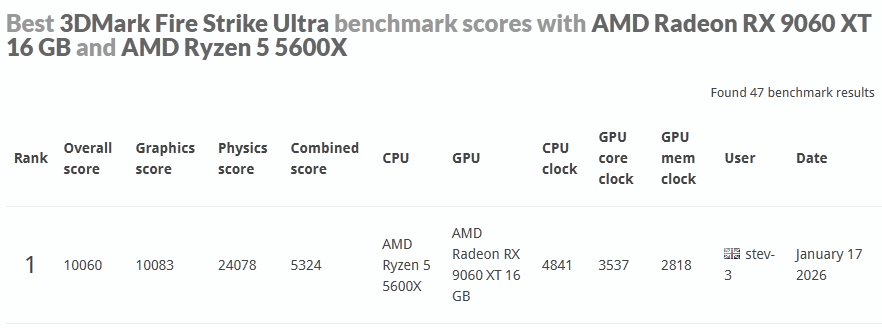
The result? A 'Legendary' score in Fire Strike Ultra (Global #1). The setup is unorthodox; the results? Undeniable.
Click to see OC results
- Max Frequency Offset: +300MHz
- Voltage Offset: -110mV
- Memory Frequency: +300MHz
I'm sure there's a little more to squeeze...
Physical Constraints
I built this SFFPC (FormD T1.2) in December 2020. Five years invites a refresh, and while the fit was already tight, the new card pushes it further. Like my previous 3060 Ti, the new card occupies two slots, though fan clearance is tighter than before. The heatsink headroom, however, is a luxury. Even at stock settings, the card whispers. With an undervolt and capped frame rates, the fans rarely bother to spin.
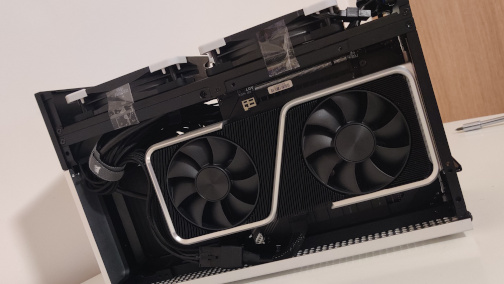
The FE cards really are pretty.
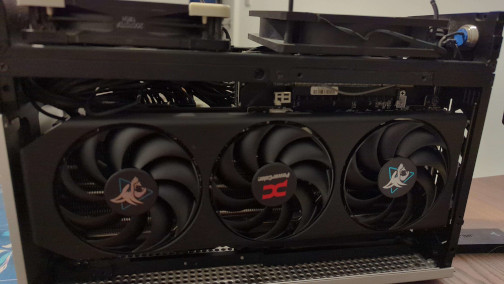
Now with less tape!
Architectural Constraints
Hardware limitations also dictated the choice. The original FormD T1 relies on a PCIe Gen 3 riser. More modern NVIDIA 60-series cards use a Gen 5 x8 bus; running them on a Gen 3 riser halves the lane count and cripples performance. The AMD card utilises the full x16 width, bypassing this bottleneck and with a lesser premium for 16GB of VRAM to boot.
The difference is stark. My previously tweaked 3060 Ti barely grazed the 50th percentile in this scenario. Satisfyingly, this replacement delivered a precise +33.3% bump in 3DMark score!
Ecosystem Switch
Divorcing from NVIDIA wasn't entirely painless; FSR 4 still trails DLSS. Though, DLSS 4.5 performs poorly on pre-4000 series hardware, making the break-up more amicable...
Beyond raw numbers, the move is strategic. An all-AMD architecture favours the pending Linux migration. Formerly, proprietary drivers were the primary source of domestic dispute; recent promises of their openness have been largely performative. This hardware promises a smoother transition.